

News [Korea Heritage Service]The world of unique characters born from Korea…
페이지 정보

본문
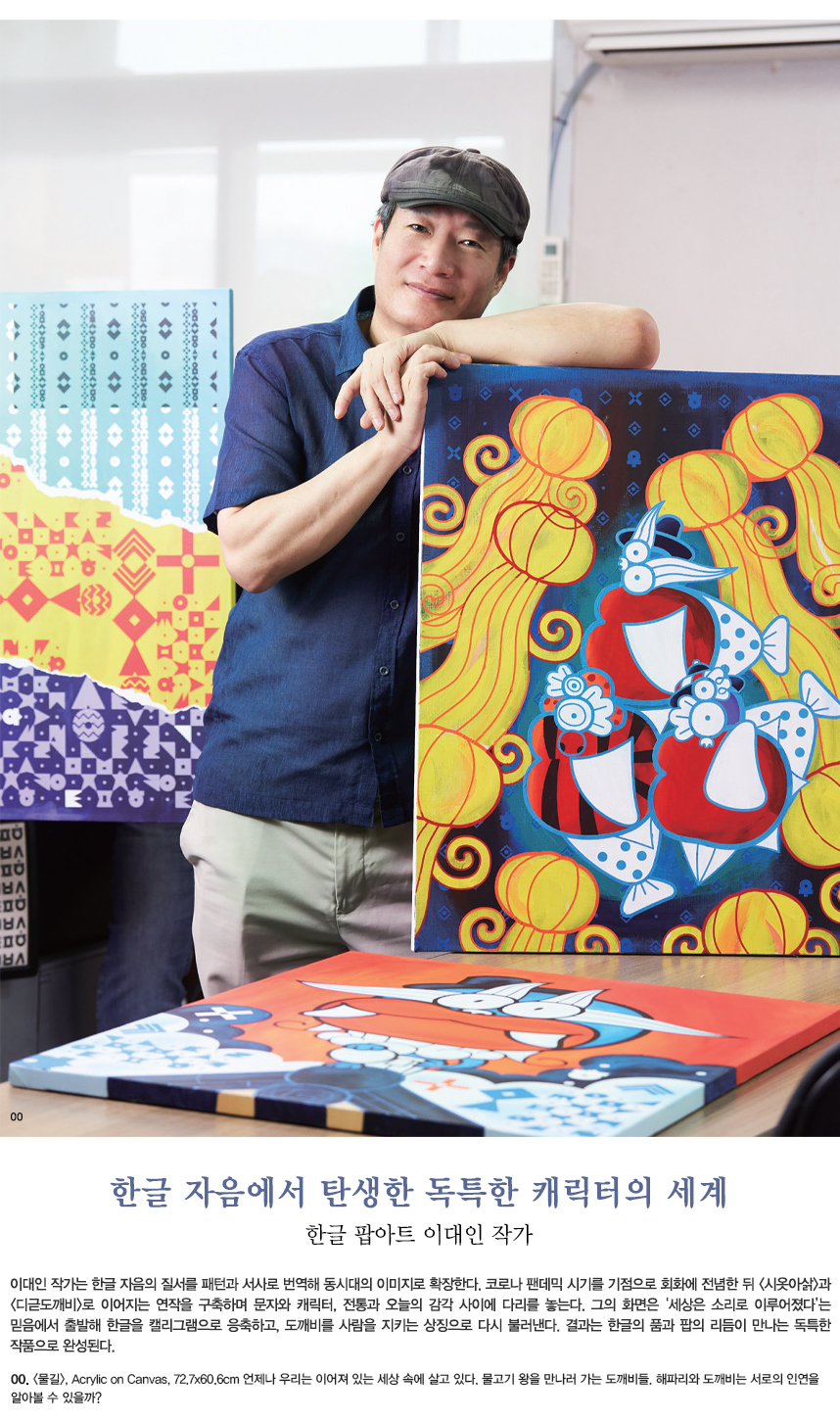
Having devoted himself to painting since the COVID-19 pandemic, he bridges the gap between letters and characters, tradition and today's sensibilities by building a series of works, including and .
His paintings, which start from the belief that ‘the world is made of sound,’ condense Hangeul into calligram and calls out the goblin as a symbol that protects people. The result is a unique work that combines the beauty of Korean and the rhythm of pop music.
Welcome to the world of Miss Giyeok and Mr. Nieun
Artist Lee dae in starts from ‘sound.’ Starting from the hypothesis that everything in the world contains waves, he holds onto Hangul as the system that most precisely expresses those waves. Thus, his work moves from letters that record sounds to abstract patterns, and then to characters with stories. Using Hangul as a subject, the artist arranges the order of sounds on the canvas through calligraphy, trying to make the viewer experience ‘readable abstraction’ in the grammar of rhythm, spacing, and repetition. This worldview emerged from the imagination of giving a contemporary ‘return song’ to〈Dongdong〉, a representative Goryeo song from the Goryeo Dynasty, and finally settled into the worldview of ‘Miss Giyeok (ㄱ) and Mr. Nieun (ㄴ).’ At its core, the setting is that animals who gathered to speak learn Hangul, an easy-to-learn alphabet system, and transform into the people they want to be.
Among his consonant characters, "Hieut" (ㅎ) forms an unusually independent axis. Due to its stable form and unique symbolism, it was separated into a separate series and even registered as a trademark. Since then, ‘Hieut’ has been used as a symbol that drives the power of the screen without any character, evoking a rhythm of sound through the spacing and repetition of consonants and vowels.
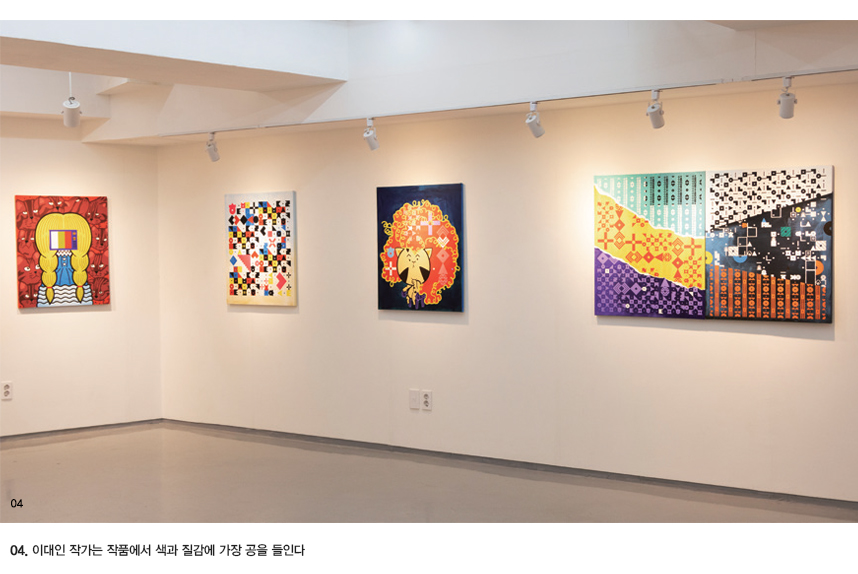
Color and texture are the areas where he puts the most effort. Even after going through sketches and digital blueprints to enhance the materiality, he boldly covers and redraws the canvas just before completion to find a balance between rhythm and density. Straying from the method of producing one piece a day, he adopts a rhythm of boldly stopping and taking detours when he run out of ideas. On the other hand, he crosses genre boundaries with ease. During the work on the wall of the rest area at the Jincheon National Training Center, he proposed the motif of ‘Heaven, Earth, and Human,’ the principles of the creation of Hangeul, and designed the moving line with the concept of the wave energy permeating the viewer's body. Beginning with his proposal to ‘design the national team uniform in Hangeul,’ this collaboration was realized after approximately two months of on-site visits to refine sketches and plans.
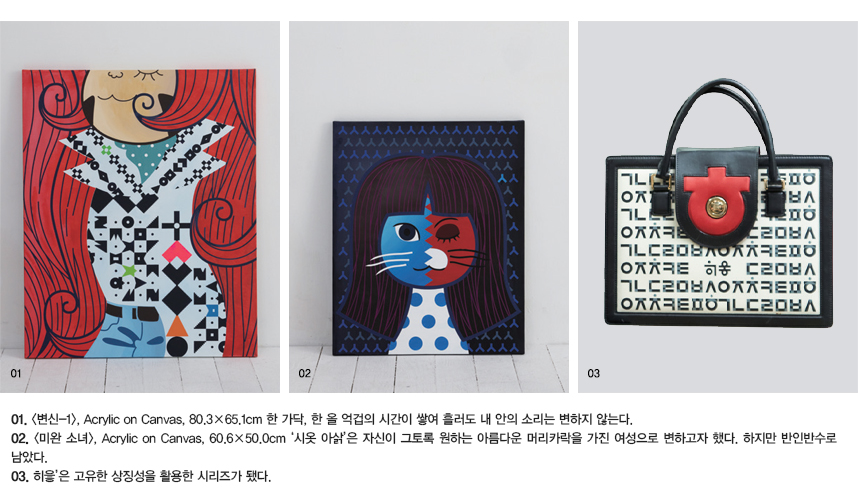
The second axis of his world of artwork is Dokkaebi (goblin). The artist interprets Korean dokkaebi as a being that ‘protects people without harming them.’ Based on this perspective, he is creating a series titled〈Diggut Dokkaebi〉. The first chapter is recently released 〈Pungeoje〉, which references folk culture, such as Ttibaennori (Ttibae Boat Festival), to express the atmosphere of prayer and protection through color and pattern. The next chapter is .
Defining the role of art in times of war as ‘waves calling peace,’ he is envisioning a performance called ‘Sound of Peace String,’ which produces a single original painting against the backdrop of a symbolic location from each country and delivers it to leaders. His imagination is to connect the Earth with the invisible string—the waves of resonance—created when recalling the same sound from different locations. The final work in this series is planned to be , which depicts a festival after peace. The three exhibitions, titled ‘Pungeoje - Pyeonghwamanseon – Makgeolli,’ are structured to gradually expand the message of peace. The each actual exhibition will consist of approximately 20 paintings, and he focuses more on establishing the texture of colors than anything else.
[Profile]
Lee dae in
May 2025 Hangul Pop Art Exhibition 〈Diggut Dokkaebi〉
August 2024〈Diggut Dokkaebi〉Exhibition at the Emile Dokkaebi Museum
December 2023 Collaboration with the Korean Sports Council's national
teamJune 2023 Hangul Pop Art Exhibition
May 2020 Development of pictogram signs for Seoul City Hall
November 2016 Korean cooking cartoon series in the Hankyoreh newspaper
Written by Choi dae gyu | Photos by Go in sun | Artwork images by Lee dae in
Source : Korea Heritage Service
https://www.khs.go.kr/cop/bbs/selectBoardArticle.do?nttId=91749&bbsId=BBSMSTR_1008&pageIndex=1&mn=NS_01_09_01

